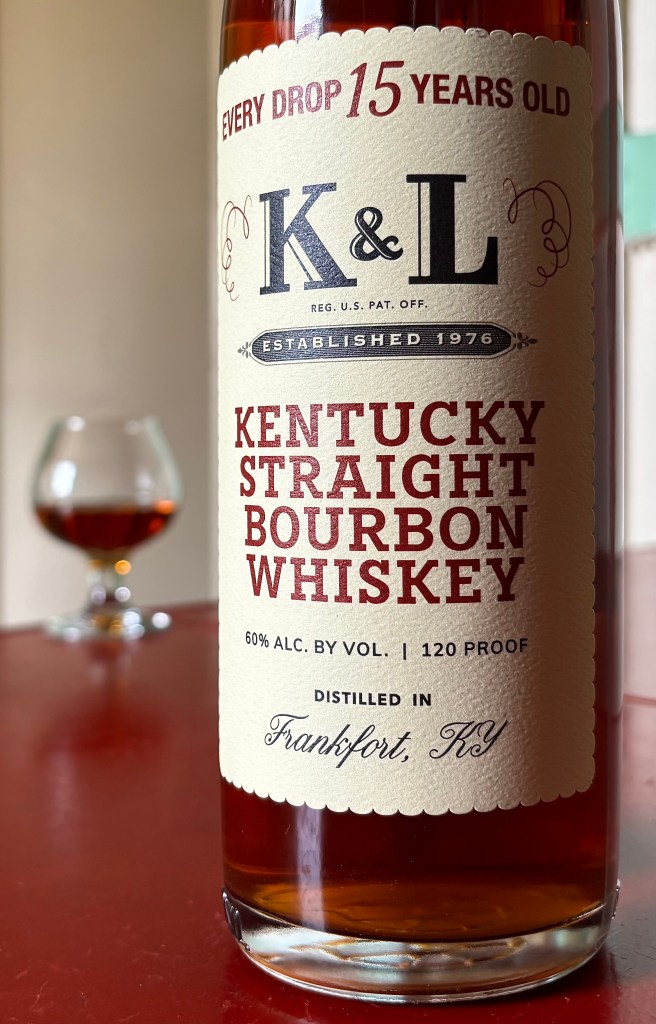
K&L LIQUORS EVERY DROP BOURBON
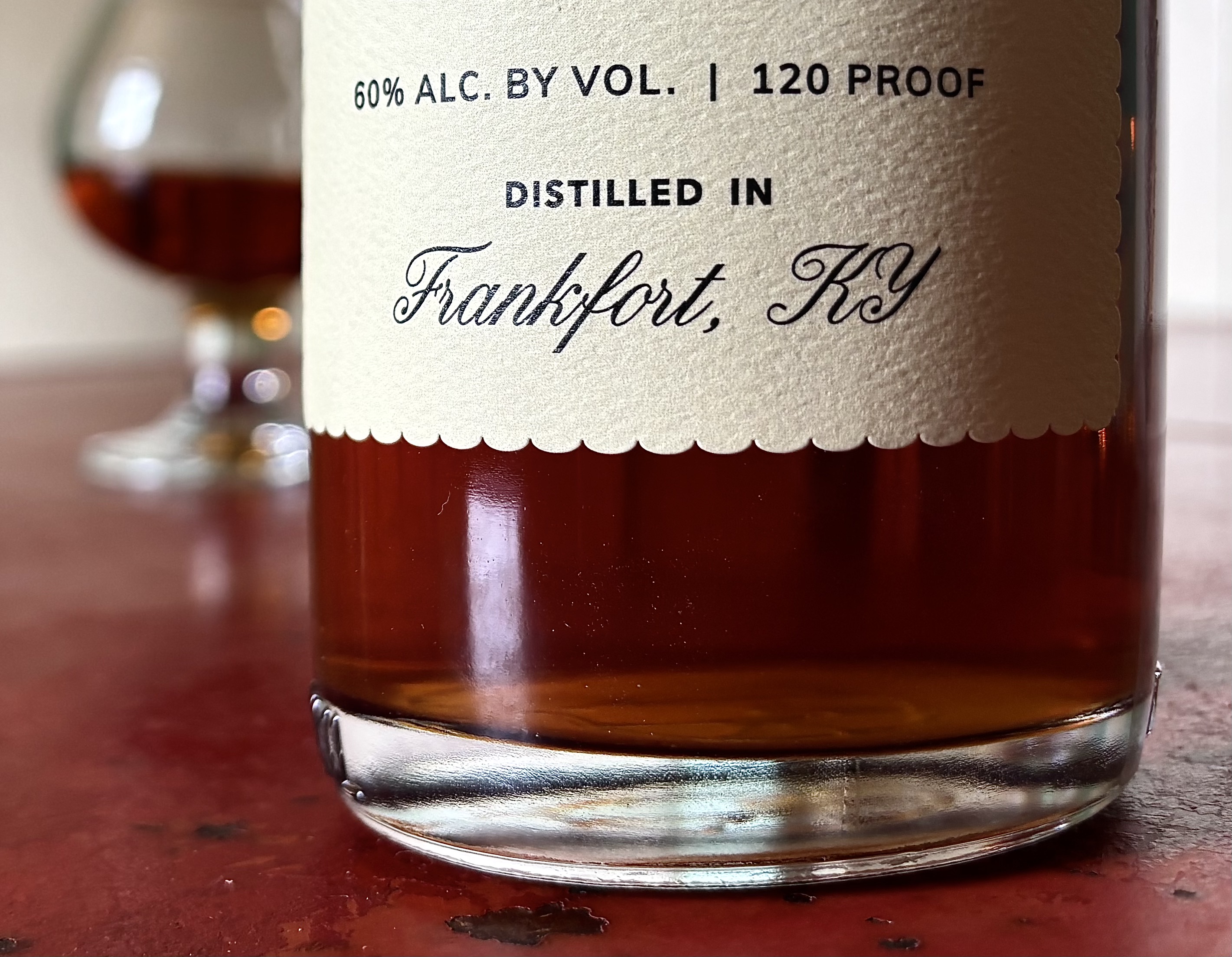
Batch No. KY-01-25 (2025)MASH BILL – 75% corn, 13% rye, 12% malted barley
PROOF – 120
AGE – 15 years
DISTILLERY – unstated (Buffalo Trace contract distilling for Wild Turkey)
PRICE – $217
WORTH BUYING? – Yes
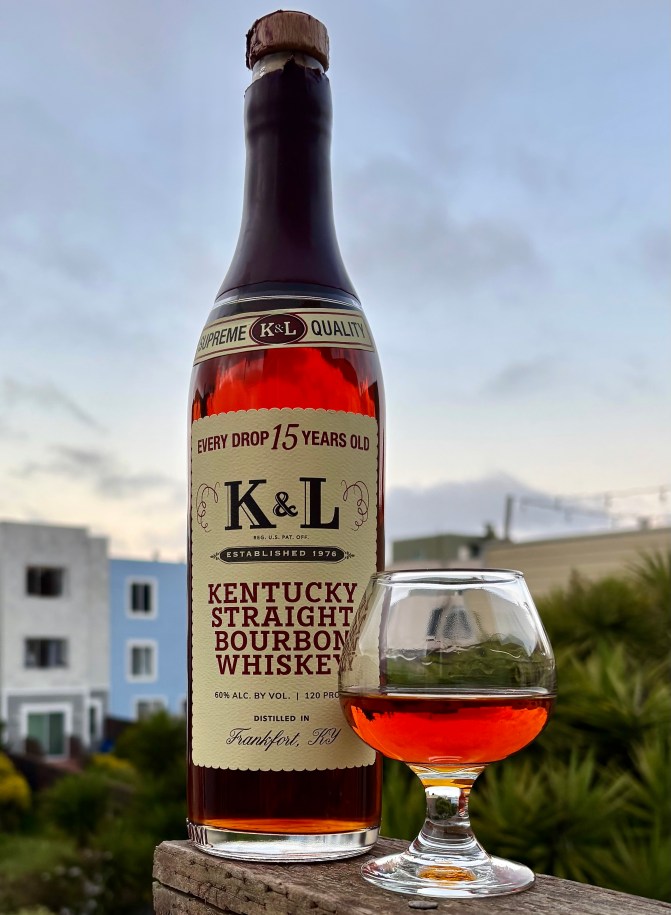
In 2024, several non-distiller producers (NDPs) began to put out sourced Kentucky bourbon aged 14 to 16 years, featuring a classic 75/13/12 mash bill most associated with Wild Turkey and Knob Creek. Wild Turkey is based in Lawrenceburg, and Knob Creek in Clermont. But these NDP bourbons were distilled in Frankfort. There are a few distilleries in Frankfurt, the biggest among them being Buffalo Trace.
So who did what in making this bourbon? And why did it all go to NDPs? Long story short, as confirmed by Bruce Russell of Wild Turkey:
Back in 2008, Wild Turkey was getting some new distilling equipment up and running and they were concerned about a break in production capacity. So they contracted with Buffalo Trace to make some bourbon for them. Though the Wild Turkey mash bill ratio was used, every other aspect of the liquid and process was Buffalo Trace—the grains, yeast, barrels, a 125 entry proof instead of Wild Turkey’s 115, everything. Once barreled, the bourbons then aged in Wild Turkey’s warehouses. So it’s 100% Buffalo Trace bourbon, made with a mash bill ratio they never use but that Wild Turkey does, and aged in the microclimates of Wild Turkey’s warehouses. The resulting flavor profile, however, was deemed too distinct from Wild Turkey to be used under their own label.
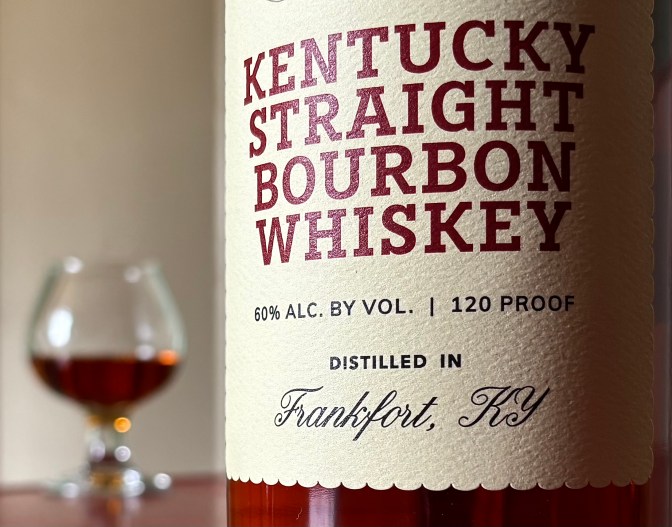
Needless to say, NDPs were quite eager to gobble these barrels up and put them out under their own labels. Contractual obligations prohibit any NDP from naming Wild Turkey or Buffalo Trace’s involvement. But whiskey geeks are persistent in their sleuthing. And many NDPs have dropped hints to offer clues without violating their contracts. As the hints and clues accumulated, these special whiskeys were soon nicknamed “Buffalo Turkey.”
Most of these “Buffalo Turkey” releases have been priced at $300 to $500 a bottle. But K&L released theirs for $200. That’s still a hefty price. But I bit.
And how is it?
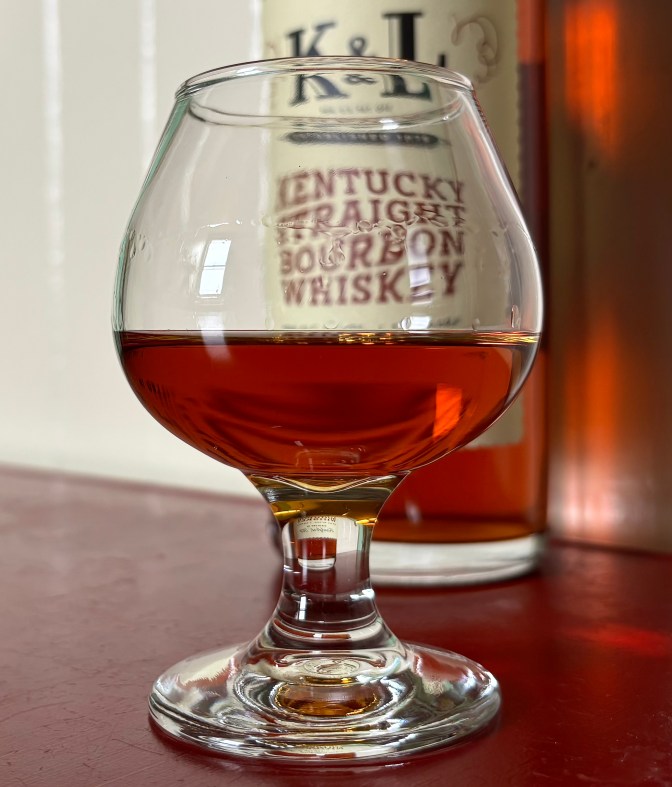
Here we are, nearing two weeks after uncorking and two pours into the bottle. After warming up my palate with some Eagle Rare, these brief notes were taken using both a traditional Glencairn and simple brandy glass.
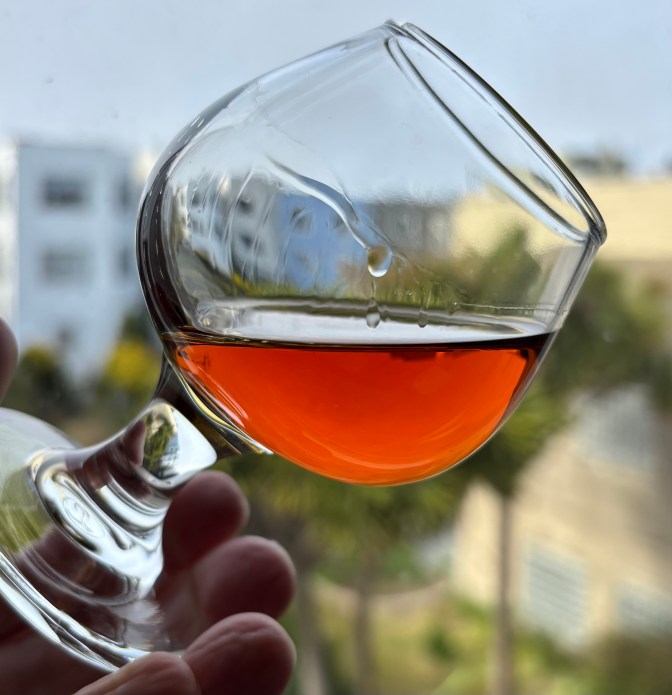
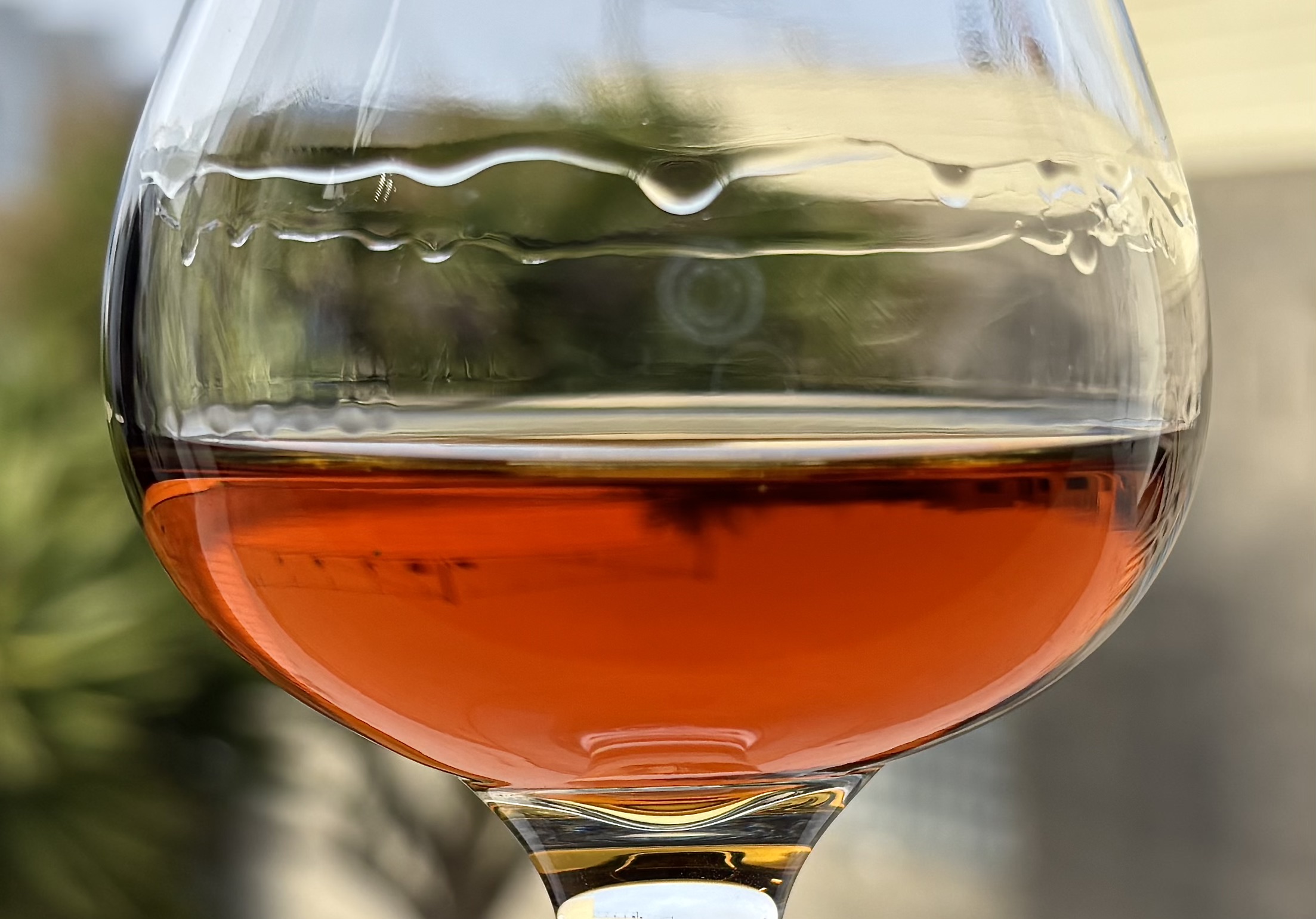
COLOR – rich, deep, vibrant orange, thick and drippy in the glass
NOSE – perfectly balanced oak, cherry, and caramel; along with a dusting of powdered dark chocolate, chocolate fudge, a crisp dry twiggy note, and something herbal like tarragon
TASTE – the various herbal notes blend into the caramel as in a soup, the cherry now baked and subtler, with coarsely ground black pepper, and a strongly etched edge toward the back of the throat from the proof and oak tannin
FINISH – long and lingering; the herbal notes mulchy now, subtle but stronger than the caramel or fruit; eventually the cherry note eases forward again
OVERALL – old-school and unexpected, classic and unique
Yes, definitely a Buffalo Trace bourbon and not a Wild Turkey product. To my sense memory, it’s most like George T. Stagg. The age and ABV certainly match, along with core Buffalo Trace cherry and aged oak notes. But there is a much more decisive herbal note at work here that is unique to this whiskey. I’m especially struck by how this herbaceous quality evolves from the nose through to the finish, from dry to soupy to mulchy.
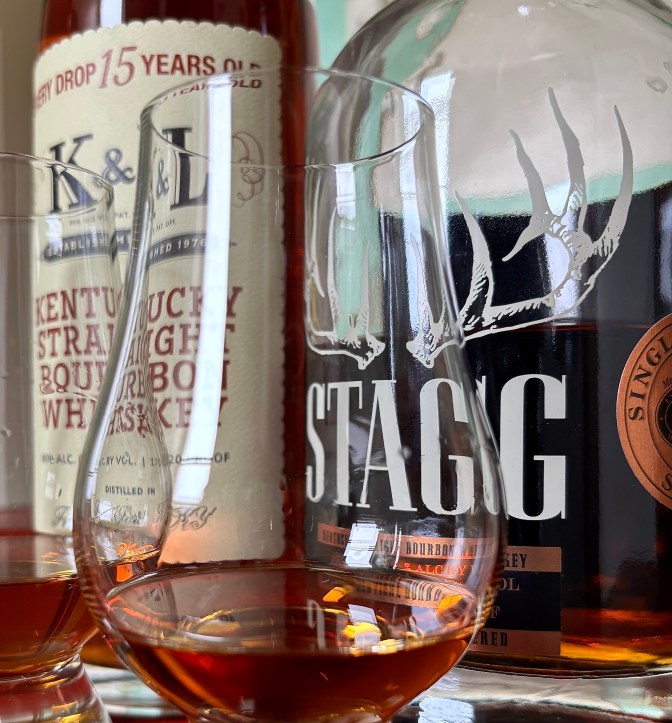
I poured a bit of Stagg (formerly Junior) single barrel, also picked by K&L. Its age is unstated. But the proof is 123.4, not far off from the “Buffalo Turkey” release.
Their colors are a very similar vibrant orange, indistinguishable when held up side by side. On the nose, the family resemblance is immediately clear in the oak and cherry notes. Now the herbal aspect of the “Buffalo Turkey” combines with its sweet notes to create a kind of white sugar frosting effect, with that mulchy aspect of the herbs lurking just beneath. Meanwhile, the Stagg offers an apple note alongside the cherry that is very Buffalo Trace.
On the taste, the similarities continue. Here I’m aware of the Stagg’s own herbal notes, which come across as less complex and varied than the “Buffalo Turkey.” And whereas the edginess I noted toward the backend of the “Buffalo Turkey” has rounded out a bit now, the Stagg’s edge remains distinct. This particular Stagg SiB has been held back for me by its edge, which has a kind of nagging annoyance to it rather than adding depth or complexity.
At this point, my senses now thoroughly warmed by the substantial proof at work, the finishes of the two whiskeys are difficult to distinguish. But overall I would say the “Buffalo Turkey” offers a more intriguing and complex experience, while the Stagg SiB is familiar lower-end Buffalo Trace barrel proof stuff, brash and lacking in refinement.
Something this K&L entry into the “Buffalo Turkey” phenomenon highlights for me is the old question: What aspects of the whiskey making process are most impactful on flavor? Many distilleries work with mash bill grain ratios that are fairly similar. And mash bills, grain and water sources, the type of distilling equipment used, barreling, warehousing, these factors are generally shared openly. Terroir is likewise a readily known factor, emphasized in marketing by smaller distilleries in particular. When I interviewed Mike Steine, senior distiller at Woodinville Whiskey Company, with regard to grains, terroir, and flavor he said:
“If we switched our corn supplier tomorrow, I could probably taste the difference and people with highly attuned palates probably could. But the majority of casual bourbon drinkers probably wouldn’t pick up on it. Moving facilities, however—say, if we moved this distillery fifty miles away from here—that would absolutely effect the flavor.”
This comment had to do with the fact that Woodinville uses open-air fermenting vats, allowing the regional bacteria to enter their mash and have its influence.
Unlike the various factors noted above, it’s very common for distilleries to guard their proprietary yeast strain closely. If it’s so worth keeping secret, is the yeast the decisive factor in flavor then? Mike Steine made this telling comment:
“The only thing I will never tell you is what yeast strain we use. But I’ll tell you anything else.”
So maybe yeast is indeed the key.
In any case, at Wild Turkey’s request, Buffalo Trace rendered a unique bourbon that, although not ultimately suited to Wild Turkey’s needs, offers a genuinely intriguing riff on the familiar Buffalo Trace bourbon experience.
And thanks to K&L, a retailer known for its integrity, this release was made available at a price one needn’t bother even hoping to find the annual Buffalo Trace BTAC offerings for these days. What once went for $200 now goes for $1000+. Yet here in my glass I have something at once familiar and unique, for pre-2018 secondary pricing. I’m very glad. Thanks K&L!
Cheers!

 The Right Spirit